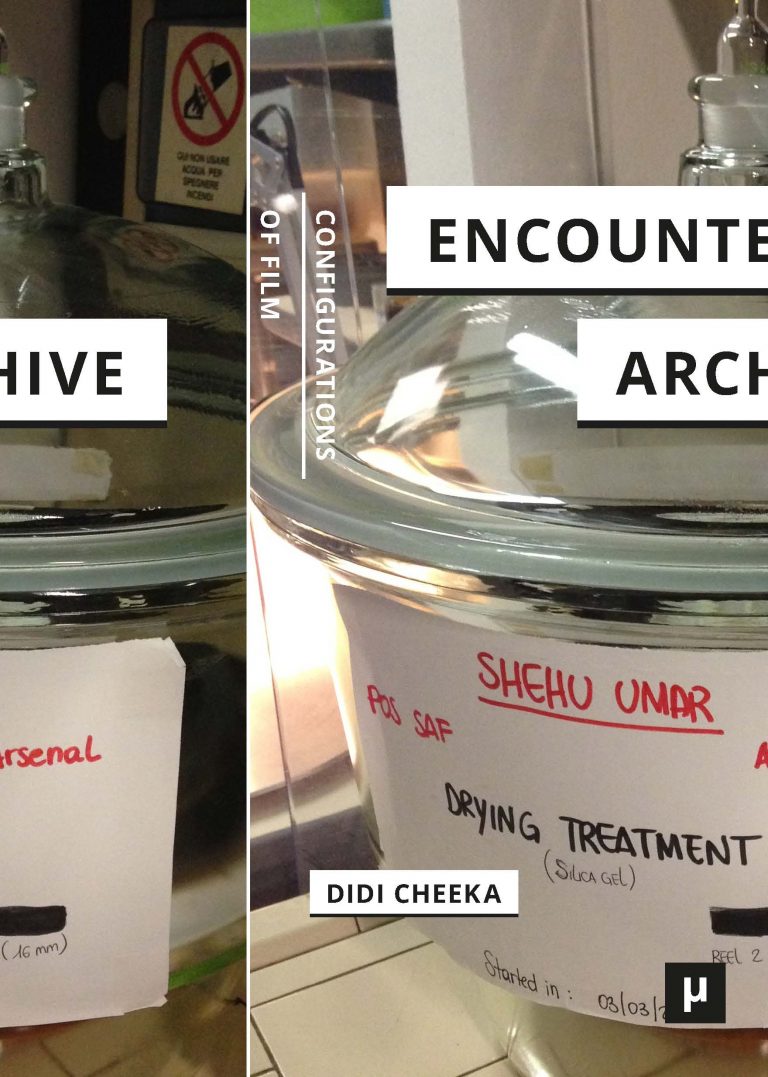
Theo­rizing the intersection of colonialism, post-nationalism, and political amnesia in what is usually referred to – with a contested term – as post-colonial society, Encounter in the Archive offers a critical challenge to, and a vision for, institutional archive-keeping practice in the third world.
Encounter in the Archive

The Struggle to Reclaim Nigeria’s Audiovisual Heritage

The chance discovery of a collection of decaying, rusted film materials in the dusty rooms of the semi-abandoned old Colonial Film Unit in Lagos leads to this manifesto about archival interventions on the African continent. Theo­rizing the intersection of colonialism, post-nationalism, and political amnesia in what is usually referred to – with a contested term – as post-colonial society, Encounter in the Archive offers a critical challenge to, and a vision for, institutional archive-keeping practice in the third world.
September 2026

Buy print version via
Publishing Year
2026
Series
License
CC-BY-SA 4.0
ISBNs
978-3-95796-103-7 (Print)
978-3-95796-104-4 (PDF)
DOI
10.14619/1037
Available as
Print, PDF

The Author

Didi Cheeka is the artistic director of Decasia – Berlin-Lagos Archival Film Festival. He is co-founder and curator of Lagos Film Society – an alternative cinema centre dedicated to founding Nigeria’s first arthouse cinema. Didi is currently engaged in digitizing and researching Nigeria’s rediscovered colonial and post-war (1967-70) audiovisual archives.

Didi Cheeka's Author Profile

This book belongs to the

Global Solidarity and/in Cinematic Practices

In interviews with leading scholars, curators and archivists this volume re-examines the legacies of internationalist solidarity in the cinema. Acknowledging film’s profound impact on political culture, these conversations open onto a broader…

Encounter in the Archive

The chance discovery of a collection of decaying, rusted film materials in the dusty rooms of the semi-abandoned old Colonial Film Unit in Lagos leads to this manifesto about archival interventions on…

Revisiting German-Speaking Film Exile

The book takes a transnational and interdisciplinary approach to examining the lives and legacies of film professionals displaced by the Nazi regime. It explores the varied experiences of exile and sheds light…

Property

To possess something is to lose something: Start­ing from this seemingly contradictory claim this essay invokes various registers to defamiliarize the ways in which property structures subjec­tivity, world relations and affects. Intertwined…

Children Reinventing Cinema

Children today discover a new digital drawing tool, the camera-crayon, at a very young age. They appropriate devices such as compact cameras and mobile phones and make their own media artifacts in…

Sticky Films

Stickiness is ambiguous. Sometimes it is a problem, sometimes a solution. It holds a strong affective charge between arousal, lust and disgust. If something is sticky, it promises relation while also threatening…

Platforms and the Moving Image

Platforms and the Moving Image offers a multifaceted look at how digital platforms shape and are shaped by economic, cultural, and political forces. The collection examines the effects of gaming, social media,…

Distributed Productivities

Digital distribution produces new global cultural flows from urban centers like Lagos, Mumbai or Seoul. But it also enables new forms of distributed production in which cultural entrepreneurs cooperate across continents and…

Accidental Archivism

In the digital media ecology, archives are changing. Artists, curators, critics and scholars assume the role of accidental archivists. They shape cinema’s futures by salvaging precarious repositories and making them matter in…

Post-Cinematic Bodies

How is human embodiment transformed in an age of algorithms? How do post-cinematic media technologies such as AI, VR, and robotics target and re-shape our bodies? Post-Cinematic Bodies grapples with these questions…

Tacit Cinematic Knowledge

Moving images are increasingly finding their way into laboratories, dentist offices, clinics, airports and gyms. In these places and institutions film and moving image technologies serve to advance knowledge, to show how…

Serge Daney and Queer Cinephilia

French critic Serge Daney was a central figure in film, television and media criticism of the second half of the twentieth century. He died of AIDS in 1992, just as the concept…

Who Owns the Images?

Digitization carries the utopian promise of archival access unlimited by constraints of space and time, and with it, of new forms of research and historiographies. In reality, digital image archives pose a…

Pandemic Media

With its unprecedented scale and consequences the COVID-19 pandemic has generated a variety of new configurations of media. Responding to demands for information, synchronization, regulation, and containment, these “pandemic media” reorder social…

Medium, Format, Configuration

In contrast with media constructed as vast, ontologically homogeneous, non-localized systems, formats show material networks of interoperability and exclusions, inscribed in local specificities, and involving precise conditions for the circulation of images…

Tracks from the Crypt

David Bowie’s 2015 Blackstar has been understood by critics and fans alike to have a certain valedictory status. For them, perhaps for us, it is a 39-minute and 13-second farewell. A long…